
Why Academics Cannot Wait Until the Offseason
Tournament weekends create a rhythm that is hard on academics. Friday travel. Saturday games all day. Sunday bracket play and the drive home. Homework gets pushed to late Sunday night or skipped entirely. Test preparation slides. Reading assignments pile up. Over a ten-weekend season, the academic slide can be significant, and for student-athletes who travel frequently with their teams, the disruption compounds.
The stakes are higher than most families realize. NCAA eligibility requires sixteen core courses completed in high school with a minimum GPA that scales against SAT or ACT scores. A student with a 2.3 GPA needs a significantly higher test score than a student with a 3.0. Falling behind in even one core class can trigger a cascade that closes the door on collegiate athletics before a player ever steps onto a campus for a visit.
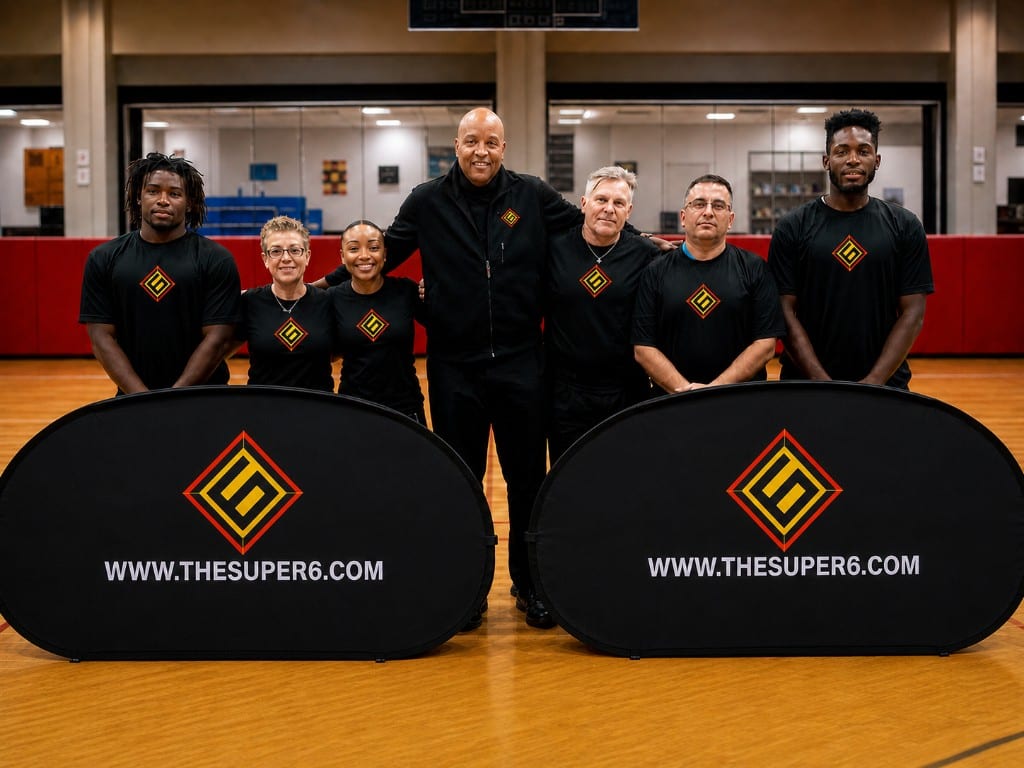
At Super6 Series LLC, we saw this problem and built a solution that fits the reality of the tournament lifestyle. Our academic tutoring program does not ask student-athletes to choose between the court and the classroom. It integrates academic support into the tournament experience, so both priorities advance at the same time.
How the Super6 Tutoring Program Works
Super6 partners with certified educators and trained tutors who understand the demands on student-athletes. They are not generalists who happen to have good grades in college. They are professionals who know how to teach, how to diagnose learning gaps, and how to work with young people who are balancing intense schedules.
Our tutors offer both in-person sessions during tournament weekends and virtual support between events. The in-person sessions are scheduled around game times so that academic work never conflicts with warm-ups or tip-off. Virtual sessions are flexible by design, accommodating the irregular hours that come with practices, travel, and school schedules.
Core subjects covered include mathematics (from pre-algebra through calculus), science (biology, chemistry, physics), English (reading comprehension, essay writing, literary analysis), and social studies (U.S. history, world history, government, economics). AP and honors coursework is supported. SAT and ACT preparation is available for upperclassmen approaching the testing window that will determine their NCAA eligibility sliding scale.
Three Focus Areas That Drive Results
Subject mastery
The first priority is understanding the material, not just finishing the assignment. Our tutors work with students to identify the specific concepts causing difficulty and build understanding from the ground up. A student who is struggling with quadratic equations does not need someone to do the homework for them; they need someone to help them understand why the quadratic formula works and how to apply it. That depth of understanding carries forward to tests, to subsequent courses, and to the standardized exams that determine college admissions.
Study skills
Many student-athletes have never been explicitly taught how to study. They rely on last-minute cramming, re-reading notes, and hoping for the best. Our tutors teach evidence-based techniques: active recall, spaced repetition, Cornell note-taking, and test-taking strategies that reduce anxiety and improve performance. These are not basketball-specific skills, but they are skills that every student-athlete needs to survive college, where the academic demands intensify and the support structures thin out.
Time management
The student-athlete schedule is uniquely demanding. A typical week might include five school days, four practices, two games, travel, and the normal load of homework and studying. Without a system, important tasks fall through the cracks. Our tutors work with students to build weekly plans that account for every commitment and protect time for sleep, recovery, and the unstructured downtime that prevents burnout. The goal is not to fill every hour with productivity; it is to ensure that the important things get done so the student can focus on basketball without academic anxiety running in the background.
College Counseling: Beyond the SAT Score
Good grades open the door to NCAA eligibility, but they do not guide a student-athlete through the recruiting labyrinth. Our college counseling program picks up where academic support leaves off.
We help families understand the differences between NCAA Division I, II, and III, NAIA, and junior college pathways. We explain the recruiting calendar: when coaches can contact players, what constitutes a dead period, and how unofficial and official visits work. We review highlight reels and offer honest feedback about what college coaches are looking for. We help families evaluate offers not just by athletic promise but by academic fit, financial aid packaging, and long-term career prospects.
The most important conversation we have with families is about fit. A full scholarship to a program where a player will sit on the bench for four years is not necessarily a better outcome than a partial scholarship to a program where they will start as a sophomore and graduate with a degree that launches a career. We encourage families to think in decades, not in recruiting cycles.
Enrollment and Communication
Parents enroll their child in tutoring through a simple intake form on our website. We ask about the student's grade level, subjects of concern, current GPA, and tournament schedule. From there, our academic coordinator matches the student with a tutor who specializes in the relevant subjects and creates a personalized support plan.
All tutoring sessions are documented with progress notes shared with parents, so families stay informed about what was covered and what needs continued attention. We also communicate with teachers and school counselors when parents request it, ensuring alignment between our support and the classroom curriculum. This coordination is especially valuable for student-athletes who are on the NCAA eligibility bubble and need every stakeholder pulling in the same direction.
What the Results Show
Student-athletes in our program report higher confidence in the classroom, better time management habits, and improved grades. Coaches notice the difference too: players who are not stressed about falling behind in school are more focused, more coachable, and more present on the court. The mental bandwidth that gets freed up when academic anxiety is reduced transfers directly to athletic performance.
The ultimate measure is not a test score or a GPA increase, though those metrics matter. The ultimate measure is what happens when the final buzzer sounds on a playing career. Our student-athletes walk into college prepared, graduate with degrees, and build lives that extend far beyond the court. That is the Super6 model. That is why academics sit at the center of everything we do.
For more about our approach, see our mission, our college prep tournaments guide, or the FAQ. When you are ready to bring your team into a program that prioritizes the classroom as much as the court, registration is open.